Quantcast
Channel: Unframed The LACMA Blog
Viewing all 883 articles
Browse latest View live

Mark Rothko: Red on Red

$
0
0

I recently caught a showing of John Logan’s play Red, which first premiered in London in 2009, making its debut on Broadway one year later. The performance focuses on fictional exchanges between artist Mark Rothko and his young assistant in 1958, a year when Rothko accepted a $35,000 commission to paint a number of murals for a new restaurant in New York City.

Red-Program Cover

Program for Red

Born Marcus Rothkowitz a 110 years ago today, Mark Rothko was an émigré from Latvia who came from humble beginnings. He attended Yale University in 1921 on scholarship, only to drop out a few years later to focus on his art in New York City. After working with the Arts Students League and the Works Progress Administration (under the Federal Art Project) in the 1920s and 1930s, respectively, Rothko had achieved critical acclaim with his color-field paintings, a style of Abstract Expressionism in which works typically comprised of large, solid planes of color rendered on flat surfaces. By the time Rothko was invited to participate in the restaurant commission, his name was already well established in the Abstract Expressionist circles,  which emerged in the United States and included painters such as Adolph Gottlieb, Clyfford Still, Robert Motherwell, and others.

The commission Rothko accepted was envisioned as an “environment” of murals for the Four Seasons Restaurant in the newly built Seagram Building, a skyscraper on Park Avenue designed by architect Ludwig Mies van der Rohe, who was noted for his functional modernist design. Having had created a of number murals in 1959, it is interesting to note that Rothko had abruptly cancelled the commission after the restaurant opened to the public. Reasons behind the cancellation varied, but in 1959, Rothko himself ultimately explained to his friend John Fischer, “I accepted this assignment as a challenge, with strictly malicious intentions . . . I hope to paint something that will ruin the appetite of every son of a bitch who ever eats in that room . . . ” A couple of years later, Rothko’s assistant, Dan Rice, recalled Rothko saying, “Anybody who will eat that kind of food for those prices will never look at a picture of mine.”

Red is a drama that offers fictional insight as to what might have been the reason Rothko quit such a hefty commission at the time. One of the more memorable exchanges in the performance is the volatile tête-à-tête (mainly by Rothko) when he asks his young assistant, Ken, “What do you see?” after looking at one of his murals. Ken’s response is eponymous with the title of the play, Red. In the performance, the audience witnesses Rothko, the expert, training the novice with verbally explosive discourse in what would have been typical Rothko fashion.

After taking a walk in our galleries, it’s an appropriate question when contemplating Rothko’s White Center (1957), currently on display:

Mark Rothko, "White Center," 1957, David E. Bright Bequest, © 1998 Kate Rothko Prizel & Christopher Rothko / Artists Rights Society (ARS), New York

Mark Rothko, White Center, 1957, David E. Bright Bequest, © 1998 Kate Rothko Prizel & Christopher Rothko / Artists Rights Society (ARS), New York

So now I ask you readers: what do you see?

Devi Noor, curatorial assistant


Art Catalogues on Station to Station

$
0
0
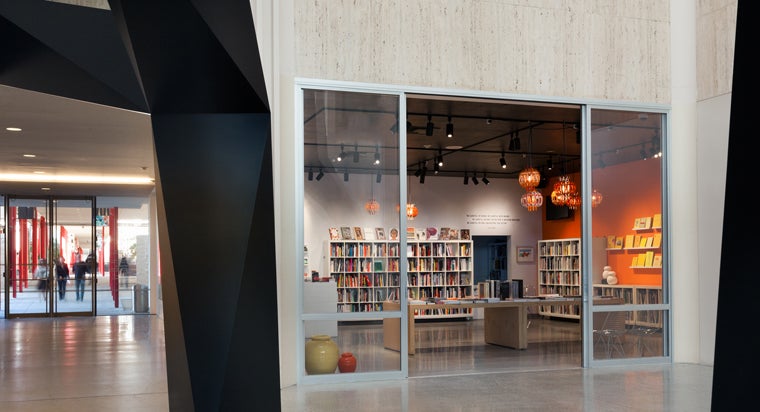
Station to Station arrives in Union Station this evening, bringing with it the pop-up shop for Art Catalogues. Founded in 1977 by Dagny Corcoran, the bookstore specializes in current and out-of-print art books and exhibition catalogues, and is currently housed at LACMA, adjacent to Tony Smith’s Smoke. In anticipation of the event in Los Angeles this evening, Unframed‘s Linda Theung asked Dagny about her upcoming experience as part of Station to Station.

Art Catalogues at LACMA

What are you learning about an itinerant version of a bookstore vs. a brick-and-mortar setup?
What a great idea Doug Aitken had to create a kind of nomadic collaboration of creative people, and the challenge of thinking about how to respond to being “itinerant” is very interesting for me. Doug’s strong point is managing to intercalate many moving parts (remember “threading the needle” on horseback?), but because he himself is an artist, he does not micromanage. I have to figure out how to get books to Winslow (where I am meeting the train), how to set up shop without knowing where that will be within the installation, how to manage to be a salesgirl as well as part of the audience. It has made me realize that Art Catalogues can—probably should—be everywhere, and it has helped me think about the e-commerce store that Amy Heibel is creating for Art Catalogues. A good question is how to make a virtual store as interesting as a brick-and-mortar one.
The video projections in Barstow. Brian Doyle courtesy of 303 Gallery, New York Station to Station is an artist-driven public art project made possible by the Levi’s® brand. ©Station to Station, Doug Aitken, 2013

The video projections in Barstow. Photo by Brian Doyle courtesy of 303 Gallery, New York. Station to Station is an artist-driven public art project made possible by the Levi’s® brand. ©Station to Station, Doug Aitken, 2013

How does having artists whose books you’re sharing change the conversations you’ve having about the printed page with visitors/participants?

It’s perfect being at LACMA, and simultaneously participating in Station to Station, because I am in the presence of all the artists, curators, films, exhibitions, and . . . unexpected encounters . . . that happen in both situations. It gives me ideas. Hosting the artists’ talks at the museum is wonderful because often people find Art Catalogues for the first time. It’s like, “Huh? What’s going on here? Where is the gift store?” Then they sort of hang around and listen and look at the books, and many times the door just opens for them, and they get it, and the’re hooked.Presenting books on the train, in the on-board llibrary, was also very much of an opportunity for me to learn more about the participating artists. I’ve become very interested in Pierre Huyghe and Mathias Poledna, artists I knew, of course, but have now begun to think about much more. And I discovered artists I didn’t know, as well.
Ye Rin Mok A wide view of the Barstow Happening. Station to Station is an artist-driven public art project made possible by the Levi’s® brand. ©Station to Station, Doug Aitken, 2013

A wide view of the Barstow Happening. Photo by Ye Rin Mok. Station to Station is an artist-driven public art project made possible by the Levi’s® brand. ©Station to Station, Doug Aitken, 2013

Is the book setup different from city to city, or does it stay pretty consistent throughout the run of Station to Station?

I haven’t the faintest idea! But I imagine it will have to be pretty fluid. The yurts change and the whole idea is evolving daily. For the pop-up stores in Winslow, Los Angeles, and Oakland, I’ll have books by the participating artists and many others that I think are relevant to the the themes of place, film, art, music and food–the questions that Doug is investigating with the Station to Station project.


This Weekend at LACMA: Two New Exhibitions, World Premiere of Restored “Rebel Without a Cause,” Free Concerts, and More!

$
0
0

LACMA will close at 3 pm on Saturday, November 2. Enjoy free general admission from 1 to 3 pm (excludes James Turrell: A Retrospective). Underground parking on Sixth Street will also be closed all day on November 2. Please park in LACMA’s lot located at Spaulding Avenue at Wilshire Boulevard.

Two exciting exhibitions open this Sunday in our galleries: David Hockney: Seven Yorkshire Landscape Videos, 2011 and Agnès Varda in Californialand. The former displays the work of one the most innovative artists from our time. Hockney took 18 cameras and recorded drives through Yorkshire’s landscape, resulting in a multi-screen grid with multiple perspectives and narratives. The latter is the first U.S. museum presentation of the “godmother of the French New Wave” and includes a new major installation and photographs. Beyond the two new shows, make sure to see See the Light—Photography, Perception, Cognition: The Marjorie and Leonard Vernon Collection, which opened only last week and presents a panoramic view of the history of photography. What’s more, we can’t recommend enough the vibrant Under the Mexican Sky: Gabriel Figueroa—Art and Film and the small but powerful Newsha Tavakolian. For a complete listing of everything on view see our list of featured exhibitions and installations.

David Hockney, May 12th 2011 Rudston to Kilham Road 5pm, © David Hockney

David Hockney, May 12th 2011 Rudston to Kilham Road 5pm from Seven Yorkshire Landscape Videos, 2011, courtesy of the artist, © David Hockney

And on our silver screen, a very special presentation of Rebel Without a Cause will take place Friday at 7:30 pm. The story of a rebellious adolescent dealing with bullies in a new town has become legendary due in part to the acting of James Dean, the star of the movie. Tonight’s event features an introduction from a special guest and is the international premier of the 1955 classic which has been recently restored and enhanced to project in 4K digital format. Additional tickets have been released but are in short supply, get yours now.

Finally, take a beat from the hustle and bustle and enjoy free, live music. On Friday Jazz at LACMA presents the Greg Porée Group, lead by the well-known leader whose previous work includes collaborations with Sonny & Cher, Diana Ross, and Gladys Knight. At Sundays Live, violinist Axel Strauss and pianist Eric Le Van come together on stage for a performance that will channel their combined years professional orchestral and studio work. Both concerts are open to the public. By the way, if you’re visiting with your family, stop by this week’s installment of Andell Family Sundays where children and their parents can bring to life animals found in Japanese art in this free artist-led workshop.

Roberto Ayala


A Remarkable Gift in LACMA’s Modern Galleries

$
0
0

LACMA has just received the remarkable donation of Max Beckmann’s Bar, Braun (Bar, Brown) (1944), a superb painting by one of the most prominent German painters of the 20th century. This masterful work comes from the most productive period in Beckmann’s career: 10 years spent in Amsterdam that must also be counted as among the most difficult and challenging years of his life. Beckmann had immigrated to Holland in 1937 immediately after Hitler’s speech against “degenerate” artists. Indeed he departed on the opening day of the Entartete Kunst (“Degenerate Art”) exhibition in which his work was vilified by the Nazis. By then there were some 30,000 Jewish and political refugees living or arriving in Amsterdam. His efforts to reach America thwarted, he remained in Amsterdam during the German occupation, departing for America only in 1947.

Max Beckmann in his studio.

Max Beckmann in his studio, © Max Beckmann Estate, photo courtesy private collection/Helga Fietz-Franke

As seen in a photograph of 1938, he was able to paint in his studio during this time and could even exhibit his work in London, New York, Chicago, St. Louis, and various other cities throughout the United States, including Santa Barbara (thanks to the efforts of his friend and patron, the writer Stefan Lackner). Yet it was extremely difficult living in the impoverished conditions of occupied Holland. The situation was especially grim when this painting was done in 1944. The Dutch population was anticipating the liberation they had long hoped for now underway, but they also feared the casualties that might result should the battle move to Amsterdam. Bars and cafés provided release and entertainment and had become a frequent subject for Beckmann, what he called the “world theater” after Lackner’s suggestion. But by 1944 few bars were even open in a city where there were constant raids, deportations, changing curfew hours, and even confiscation of bicycles just as public transportation had ground to a halt for lack of fuel. Beckmann refers to having finished a painting called Bar Tivoli in a diary entry of August 8, 1944, and if this is that painting, the scene was probably at the bar at Reguliersbreestraat 26–28, an art-deco building of 1921 that contained the most luxurious cinema in Amsterdam, along with a cabaret and bar. The Tivoli name came from the German occupiers during WWII and provides a possible reason for renaming this location in the painting. The woman looking toward the viewer is certainly Beckmann’s wife, affectionately called Quappi. An aspiring opera singer when Beckmann met her, Mathilde von Kaulbach declined an offer from Dresden State Opera House, to marry Beckmann in 1925. Seated with her is Dr. Helmuth Lüthjens, with whose family the Beckmanns lived after the allied invasion of Holland in June by which time they had become entirely destitute. Representing the Amsterdam branch of Paul Cassirer’s venerable Berlin Gallery, Lüthjens had already brought most of Beckmann’s paintings into his house to protect them from possible confiscation. Many scholars suggest that the profile at the top of the painting may be Beckmann, who often appeared in his own paintings. The identity of the figures below remains mysterious. The brown tonalities are in striking contrast with other bar and restaurant scenes of this time, such as the brightly colored The Oyster Eaters of 1943, which also features Quappi.

Max Beckmann, Bar, Braun, 1944, gift of Robert Looker

Max Beckmann, Bar, Braun, 1944, © Max Beckmann Estate/Artists Rights Society (ARS), New York/VG BILD-KUNST, Bonn

Yet Beckmann’s broadly brushed paint strokes capture a bright artificial light perhaps originating from below the figures, which lends this striking painting an extraordinary emotional intensity. A certain lack of communication among the figures is typical of many of Beckmann’s bar scenes and may also suggest existential loneliness of the individual in the modern world, a frequent subject for Beckmann from the 1920s onward.

Beckmann’s ambiguous and elastic pictorial space is indebted to Paul Cézanne, whose art he had discovered while visiting Paris in 1903–4. In 1944, Beckmann, aged 60, was a robust painter at the top of his game, able to bring a mythic quality into his paintings that few other painters could match. Here he captured not only the entirely unique mood of Amsterdam at this time, but also something timeless, perhaps the human predicament in the modern world. Among the most directly engaging paintings of this period, Bar, Brown will be a destination painting in our modern galleries, where it now hangs between Beckmann’s bronze Adam and Eve (1936) and his Bridge and Wharf (1945). The painting is given in honor of the late Robert Looker, who served as a trustee from 1998 until his death in 2012 and was an especially astute collector of German Expressionism. The Lookers’ generosity has enriched LACMA and its collections broadly, with particular concentration in the Contemporary and the Costume and Textiles holdings.

Timothy O. Benson, Curator, Rifkind Center for German Expressionist Studies


Now on View: A New Work by the Great Juan Correa

$
0
0

Just last week we acquired our first work by the great Juan Correa (1645–1716), considered along with Cristóbal de Villalpando (circa 1649–1714) to be one of the leading painters of Mexico in the late 17th century. Correa, the son of a famous Spanish surgeon and a freed black woman, was one of the few mulatto artists who achieved fame despite his racially mixed background. (The art of painting was generally considered the purview of white or Spanish masters.) His two mural-sized canvases for the sacristy of the Mexico City’s cathedral (1691–98), for example, are regarded as masterpieces of the Mexican baroque.

Juan Correa, Mexico, Angel Carrying a Cypress (Ángel portando un ciprés), c.irca 1670-–1690, oil on canvas, 160 × 107.95 × 2.54 cm. Los Angeles County Museum of Art, oil on canvas, 160 x 107.95 cm

Juan Correa, Mexico, Angel Carrying a Cypress (Ángel portando un ciprés), c. 1670–90, oil on canvas, 160 × 107.95 × 2.54 cm, Los Angeles County Museum of Art

Our painting depicts an angel standing in a golden cloud carrying a cypress, a symbol associated with the purity of the Virgin Mary. The work probably formed part of a lost altarpiece devoted to the Immaculate Conception. Stylistically, the picture is characteristic of Correa’s work from the period between 1670 and  1690 with its vibrant palette, elegant composition, and overall emphasis on decorative details (e.g., the diaphanous veils and cabochons of the angel’s attire).

Juan Correa, Angel Carrying a Cypress (Ángel portando un ciprés) (detail), c. 1670–90

Juan Correa, Angel Carrying a Cypress (Ángel portando un ciprés) (detail), c. 1670–90

The figures’ proportions, with prominent muscular white arms, are typical of Correa’s work, as are the finely detailed hands, with elongated fingers. Another element that is characteristic of Correa’s style is the impressionistic detailing of the cypress’s foliage, painted by pressing the tip of the brush against the canvas and then quickly dragging it down.

Juan Correa, Angel Carrying a Cypress (Ángel portando un ciprés) (detail), c. 1670–90

Juan Correa, Angel Carrying a Cypress (Ángel portando un ciprés) (detail), c. 1670–90

Correa was a master at creating subtle color gradations that provide a sense of iridescence and contribute to the overall mystical effect of the composition (seen here in the wings and the fabric of the angel’s boots).

Juan Correa, Angel Carrying a Cypress (Ángel portando un ciprés) (detail), c. 1670–90

Juan Correa, Angel Carrying a Cypress (Ángel portando un ciprés) (detail), c. 1670–90

Plans are in the works to analyze the painting with our conservators in order to determine the pigments and materials that the artists used, as well as the intricacy of his technique. Correa’s work represents a major keystone of our expanding collection of Spanish colonial art. The painting is now on view in our Latin American art galleries in the Art of the Americas Building.

Ilona Katzew, Curator and Department Head, Latin American Art


Four Photographs, Four Trees, Four Ways of Seeing

$
0
0

The exhibition See the Light—Photography, Perception, Cognition: The Marjorie and Leonard Vernon Collection presents 220 photographs from the Vernon Collection, one of the most important holdings of photography that spans the history of the medium. The presentation aims to identifying parallels between photography and vision science over time.

Since the invention of photography in the late 1830s, its materials and meanings have evolved in relation to theories about vision, perception, and cognition, which in turn reflect the social, political, and economic priorities of any given time and place. Todayas photographic images proliferate and find their way ever more directly into our consciousness—it seems not only possible but necessary to correlate developments in neuroscience with those in visual culture. This exhibition takes a historical perspective, identifying parallels between photography and vision science during four chronological periods.

We’ll look a grouping of four photographs of trees featured in the exhibition in order to trace the main themes presented. In this grouping, four approaches are considered: descriptive naturalism and subjective naturalism, and experimental modernism and romantic modernism. This gathering shows how standard genres—such as portraiture, still life, and landscape—could be depicted differently, depending on the artists’ priorities and choices.

Andrew Young, Plane at Aberdour. In Old Avenue., c. 1850, printed c. 1850, The Marjorie and Leonard Vernon Collection, gift of The Annenberg Foundation, acquired from Carol Vernon and Robert Turbin

Andrew Young, Plane at Aberdour. In Old Avenue., late 1870s, The Marjorie and Leonard Vernon Collection, gift of the Annenberg Foundation, acquired from Carol Vernon and Robert Turbin

The earliest example was made in the 1870s and represents the aims of descriptive naturalism. The photographer (Andrew Young) has tried to show maximum detail and information, framing the tree directly in the center and including small figures for scale. At the same time, in the middle decades of the 19th century, physiological optics concentrated on the eye’s information-gathering capacities, understood through new mechanical devices for measuring and recording the optical system’s response to light.

Robert Demachy, Toucques Valley, 1906, printed 1906, The Marjorie and Leonard Vernon Collection, gift of The Annenberg Foundation, acquired from Carol Vernon and Robert Turbin

Robert Demachy, Toucques Valley, 1902, published in Camera Work, 1906, The Marjorie and Leonard Vernon Collection, gift of the Annenberg Foundation, acquired from Carol Vernon and Robert Turbin, © The Estate of Robert Demachy

As the turn of the 20th century approached, both photographers and scientists became more interested in the subjective aspects of perception. Robert Demachy, a French photographer, demonstrates the tendency in subjective naturalism to manipulate the image, either in the camera or on the surface of the print, to evoke a mood rather than simply describe a scene. Similarly in the scientific realm, a new field called experimental psychology emerged, suggesting the role of emotion in perception.

Harry Callahan, Tree, 1956, The Marjorie and Leonard Vernon Collection, gift of The Annenberg Foundation, acquired from Carol Vernon and Robert Turbin, © 2013 The Estate of Harry Callahan

Harry Callahan, Multiple Exposure Tree, 1949, printed later, The Marjorie and Leonard Vernon Collection, gift of The Annenberg Foundation, acquired from Carol Vernon and Robert Turbin, © The Estate of Harry Callahan; courtesy Pace/MacGill Gallery, New York

With the 20th century came modernism and its revolutionary ideas. One form of modernism in photography, which emerged after World War I in Europe and America, was experimental modernism. This is evident in Harry Callahan’s work with multiple exposure—he is interested in seeing what happens when he moves the camera while the shutter is open. The image of a tree presents a graphic pattern of black lines on a white background, more than a representation of a specific tree in a specific landscape. It is nearly abstract, yet we do recognize it as a tree. This perceptual ability to make sense of minimal visual cues was of interest to the Gestalt psychologists who came to prominence during the period of experimental modernism.

Toward the middle of the 20th century, a more romantic form of modernism can be seen in photography, exemplified in the work of Ansel Adams, who believed strongly in the artist’s special vision while also advocating for technical mastery. In this photograph, Forest, Early Morning, Mt. Rainer National Park, Washington, Adams establishes a subtle range of tone, so as to convey a mood of hushed reverence for nature while also capturing each distinct leaf and texture. The issue of light-and-dark contrasts was of primary concern to both photographers and vision scientists at this time—not only must these contrasts be managed in a photographic print in order for the image to make sense, contrasts in the physical world allow us to locate objects and navigate in our environment.

Britt Salvesen, department head and curator, the Wallis Annenberg Department of Photography


This Weekend at LACMA: Free Jazz and Classical Music, A Look at Luba Art, The Stories of San Bernardino in Nicole Miller’s “Believing Is Seeing,” and More!

$
0
0

Start your weekend this Friday at 6 pm with a free, live performance at Jazz at LACMA, featuring the group House of Games. Known for their distinctive mix of jazz and fusion, the members of this group have individually worked with artists such as Ray Charles, Herbie Hancock, and Michael Bublé. The quartet, complete with guitar, piano, bass, and drums, has been thrilling audiences for decades.

Caryatid Stool, Democratic Republic of the Congo, Luba Peoples, 19th Century, Wood, glass beads, Royals Museum for Central Africa, RG 22725, Photo R. Asselberghs, RMCA, Tervuren ©

Caryatid Stool, Democratic Republic of the Congo, Luba Peoples, 19th Century, Wood, glass beads, Royals Museum for Central Africa, RG 22725, Photo R. Asselberghs, RMCA, Tervuren ©

Make your way to the Ahmanson Building on Saturday for a Gallery Tour: Luba Art, Culture, and Cosmology Saturday at 11 am. Led by curator Mary (Polly) Nooter Roberts and California State University, Northridge’s associate professor of religious studies Mutombo Nkulu-N’Sengha, the discussion covers the importance of history, the role of women , the nuances of Luba philosophy. Visit a handful of LACMA’s galleries and exhibitions on view after the tour.

Three new exhibitions debuted this month, including David Hockney: Seven Yorkshire Landscape Videos, 2011, Agnès Varda in Californialand, and See the Light—Photography, Perception, Cognition: The Marjorie and Leonard Vernon Collection. Beyond those, check out Murmurs: Recent Contemporary Acquisitions and Princely Traditions and Colonial Pursuits in India.

Viva!—Rado—Ragni—Varda in Hommage to Magritte, Agnès Varda's film LIONS LOVE (. . . AND LIES), 1968, © Max Rabb / Agnès Varda

Viva!—Rado—Ragni—Varda in Hommage to Magritte, Agnès Varda’s film LIONS LOVE (. . . AND LIES), 1968, © Max Rabb / Agnès Varda

On Sunday at the Bing Theater, see Nicole Miller’s Believing Is Seeing, a film work showcasing personal stories from San Bernardino residents that participated at the LACMA9 Art+Film Lab a few months ago and Redbelt, a film by David Mamet about a martial-arts instructor who blindly follows the code of morality. The day also includes Andell Family Sundays beginning at 12:30 pm, in which families and children are invited to craft animals found in Japanese art. See a live performance by violinist Martin Chalifour and pianist Nadia Shpachenko at Sundays Live.

Roberto Ayala


A Sighting at LACMA: Little Frida Kahlo

$
0
0

A common assumption we museum educators often face is that our job is always glamorous; that we spend all of our time surrounded by world-class works of art, bumping elbows with famous artists. Just a couple of weeks ago, we confirmed this theory.

littlefrida

Birdie, or Little Frida, attends an Andell Family Sunday.

The Andell Family Sundays staff was truly in the presence of greatness when the iconic Mexican painter, Frida Kahlo, wheeled around the corner in her push car and onto the Los Angeles Times Central Court, ready to create a masterpiece before our very eyes.  The paparazzi went wild, bringing out the big lenses to capture the moment.  She was just as stunning in person as she is in the portrait her husband, Diego Rivera, painted some 74 years ago, that now graces our museum walls.

In 1925, when Frida Kahlo was only 18 years old, the city bus she was riding in collided with a trolley car in Mexico City. The crash caused injuries that left her bed and wheelchair-ridden for months at a time. During this time, she was quoted as saying, “Feet, what do I need you for when I have wings to fly?” Her paintings kept her company during times of rest, but each time she was able to stand again, it was a milestone for her recovery.

This little Frida celebrated a similar milestone on LACMA’s campus.  Her parents—and us, of course!—were thrilled when she took her very first steps on her own! Congratulations, Birdie! Thanks for visiting us at Andell Family Sundays!

Angela Hall, education coordinator, education and public programs
Alicia Vogl Saenz,  senior education coordinator, education and public programs


Gabriel Figueroa in Collaboration and Context

$
0
0

To take a still from one of Gabriel Figueroa’s films is to capture an image that is markedly photographic. Indeed, Figueroa’s aesthetic was created without coincidence; the filmmaker was in dialogue and surrounded himself with the great modernist painters and photographers of Mexico who worked in the early half of the 20th century. In the exhibition Under the Mexican Sky: Gabriel Figueroa—Art and Film, on view in the Art of the Americas Building, curators Rita Gonzalez and Britt Salvesen aimed to present Figueroa in the context of Mexican art at large.

Gabriel Figueroa, scene from the film La perla, directed by Emilio Fernández, 1945. © Televisa Foundation

Gabriel Figueroa, scene from the film La perla, directed by Emilio Fernández, 1945, © Televisa Foundation

Gabriel Figueroa’s circle, which included artists such José Orozco, Diego Rivera, David Siqueiros, among others, were collaborative and mutually influenced one another. While the exhibition has one person’s name on it, and it’s Figueroa’s story told throughout, it’s also a narrative of creative networks and inventive teams of people.

Gabriel Figueroa, Film still from Enemigos, directed by Chano Urueta, 1933, (c) Gabriel Figueroa Flores Archive

Gabriel Figueroa, Film still from Enemigos, directed by Chano Urueta, 1933, © Gabriel Figueroa Flores Archive

Film, by its nature—the multiple entities and talents involved—is a collaborative medium. Figueroa and Emilio Fernández, who worked together on the adaptation of John Steinbeck’s La Perla (The Pearl), pushed each other to create vivid iconography of the legacy of the Mexican Revolution. Later in Figueroa’s career, when he worked with the Spanish Surrealist Luis Buñuel, there was some disparity in their viewpoints—Buñuel was not particularly interested in a monumental version of Mexico. He wanted something grittier, more ambivalent, surreal. Yet both collaborations produced numerous films. In some cases, artistic tension was productive.

Mario Ybarra, Jr. and Juan Capistran, Stick 'em Up . . . (Slanguage Bandito), 2003, © Juan Capistran and Mario Ybarra, Jr.

Juan Capistran and Mario Ybarra, Jr., Stick ‘em Up . . . (Slanguage Bandito), 2003, © Juan Capistran and Mario Ybarra, Jr.

Under the Mexican Sky also puts the work of contemporary artists in dialogue with Figueroa’s. For example, there is a section that deals with a genre called commedia ranchera, and it also includes the figure of the charro, or Mexican cowboy. Parallel to the depiction of cowboys in American Westerns, there was too in Mexico a really robust representation of the charro. In contemporary art, there have been a number of plays with the figure of the charro, namely as a representation of masculinity. A number of contemporary artists, such as Guillermo Gómez-Peña, Gonzalo Lebrija, have been mining that territory.

Through Figueroa, audiences are given an incredible overview of Mexican cinema in the 20th century. Figueroa was active for 50 years, a time that covers a lot of changes in the industry, in style, and presentation. The images in Figueroa’s films are iconic, and have informed Mexican visual identity and visual culture since the early 20th century. Under the Mexican Sky provides a capsule view of this incredible history.


Reflections on Kitasono Katue: Surrealist Poet

$
0
0

It was a great pleasure to view the exciting LACMA exhibition Kitasono Katue: Surrealist Poet. In Japan, Kitasono Katue’s reputation as an artist, designer, and photographer has been rising exponentially in the past 10 years, despite the fact that the avant-gardist—who advocated for the amateur over the professional—was proud in the latter part of his life to pose as a minor poet. In 2010, I curated the Kitasono presentation of the exhibit, Hashimoto Heihachi and Kitasono Katue: Unusual Pair of Brothers, a Sculptor and a Poet. The exhibition ran for two months at the Mie Prefectural Art Museum (where my colleague, Mori Ichiro, curated the Heihachi presentation), after which it had a two-month display at Setagaya Art Museum in Tokyo. Although not a blockbuster—it wasn’t promoted on billboards or television like some exhibitions—the work was new to the audience and drew 14,000 visitors, many of whom were young artists, art enthusiasts, and romantic couples.

vou6

Kitasono Katue, Forgotten Man (Plastic Poem), 1975, collection of John Solt

Over the past few years, retrospective exhibitions of artists have been held one after another, with the aim of reconsidering the careers of artists who flourished before World War II. Curators and researchers are aiming to reexamine this complex history by combining existing documents with newly discovered ones. Along with Kitasono and his brother, the lives and art of prominent figures such as Murayama Tomoyoshi (MAVO Group), Surrealist painter Koga Harue, and Nihonga-style painter Tamamura Hokuto (the sponsor of Kitasono’s Dada-era journal), among others, have added to a critical mass of a new understanding about the breadth and vibrancy of the activities of artists who worked in multiple fields and genres before the war.

There was a curious phenomenon after our exhibition: Kitasono Katue became an “idol” among young artists and art lovers—especially photographers, designers, and poets. Suddenly it became unhip to be unfamiliar with Kitasono and his works. Interestingly, this phenomenon finds a parallel to Kitasono’s popularity in the United States during the 1950–70s, when bohemian, Beat, and hippie poets were all familiar with Kitasono’s poems in English (self-translated), and later with his plastic poems.

Kitasono Katue (Japan, 1902-1978) Plastic Poem Homage to J.F. Bory (Hommage à J.F. Bory), 1967, on page 20 of the periodical VOU, no. 113, January 1968 approx: 8 3/8 x 7 1/2 in. (21.3 x 19.0 cm) Collection of John Solt

Kitasono Katue, Plastic Poem Homage to J.F. Bory (Hommage à J.F. Bory), 1967, on page 20 of the periodical VOU, no. 113, January 1968, collection of John Solt

The recent Kitasono boom in Japan has little to do with new findings on pre–World War II artists; rather, it is linked to the contemporary art and technological worlds. There is something about the fragmental elements of Kitasono’s words and images that relates to the way information is disseminated today.

Strolling through the exhibition at LACMA, I wondered how Kitasono’s work resonates with the diverse American audience. At the partition, without curtains between the Kitasono exhibit and the permanent collection, one can stand and reflect simultaneously on two pasts: the 2,000 years represented by the priceless examples in the permanent collection, and the half-century of work by 20th-century poet-artist Kitasono Katue. It is an important and rewarding exhibition because in the one figure of Kitasono is bridged the little-known, pre-World War II Japanese avant-garde and the better-known postwar period.

Naotoshi Noda (and Mori Ichiro) flew expressly from Tokyo to see the exhibition Kitasono Katue: Surrealist Poet at LACMA. Noda and Ichiro worked collaboratively on Hashimoto Heihachi and Kitasono Katue: Unusual Pair of Brothers, a Sculptor and a Poet, which was awarded the Japanese Association of Art Museums’ 2010 exhibit of the year. Setagaya Art Museum has carved out a niche as one of the main museums in Japan for regularly displaying Japanese avant-garde art, and occasionally it also exhibits Western painting and photography. Noda’s recalls his experience in the LACMA presentation.

Kitasono Katue at Knotts

Kitasono Katue at Knott’s Berry Farm in California

“Katue once visited the U.S. with a group of fellow librarians. He didn’t contact his literary friends—perhaps he had no time—but he made sure to have a photo of himself taken at Knott’s Berry Farm, which he made into his 1965 New Year’s greeting card and sent around.”

Naotoshi Noda, curator, Setagaya Art Museum, Tokyo


My Melodiously Magical Sunday Evening at LACMA

$
0
0

One of the perks of interning at an organization as dynamic as LACMA is becoming familiar with the variety of programs and events that take place. For instance, the Sundays Live series is a truly wonderful (and free!) opportunity to hear classical music that I had previously not explored. Thus, to rectify such an omission, I attended my first Sundays Live performance on October 27 and was greatly impressed by the caliber of talent that LACMA showcased in the cozy Bing Theater.

Capitol Ensemble

Capitol Ensemble

The performance I attended featured members of the Capitol Ensemble playing with Rina Dokshitsky a program of Romantic-era pieces by Johannes Brahms and Robert Schumann. The concert was broadcast live on KUSC, adding to the excitement of the event. As I waited for the concert to start, I observed that the audience was a diverse cross section of the community, which included seasoned classical music aficionados and likely newcomers. Notably, there were families taking advantage of the opportunity to introduce their children to classical music and students curious about the genre. The works, a violin sonata and a piano quintet, had a transcendent effect that made for a truly magical Sunday evening—the perfect ending to the weekend.

Sundays Live offers free classical concerts every Sunday evening at 6 pm, hosting a variety of musicians and ensembles. This series effectively underscores the complementary nature of visual and performing arts.

So next time you are planning your weekend, consider incorporating an experience with music at Sundays Live after out the works of art in the collection and special exhibitions. You might make connections between what you see in the galleries and onstage.

Oxana Ermolova, intern, marketing


This Weekend at LACMA: Legendary Mexican Film, Jazz and Classical Performances, Stellar Exhibitions, and More!

$
0
0

There’s only one way LACMA knows to enjoy a weekend—with live music, stunning film, and world-class art—and this week is no exception. On Friday the Tom Rizzo Group takes center stage at Jazz at LACMA. Guitarist Tom Rizzo helms this bebop-based jazz group, recognized by their dulcet tones and pulsing rhythms. Jazz at LACMA is, as always, free and open to the public. Then, in the Bing Theater, the brief but beautiful film series The Image of Mexico: Multiple Visions presents works by Mexican cinematographer Gabriel Figueroa and his legacy, as seen in the exhibition Under the Mexican Sky: Gabriel Figueroa—Art and Film. See Redes at 7:30 pm, a fascinating and influential artifact, and Let’s Go with Pancho Villa at 8:45 pm, a production with epic proportions.

Manuel Álvarez Bravo, Gabriel Figueroa reviewing light tests for the film Sonatas, directed by Juan Antonio Bardem, 1959, Gabriel Figueroa Flores Archive, © Estate of Manuel Álvarez Bravo

Manuel Álvarez Bravo, Gabriel Figueroa reviewing light tests for the film Sonatas, directed by Juan Antonio Bardem, 1959, Gabriel Figueroa Flores Archive, © Estate of Manuel Álvarez Bravo

On Saturday museum patrons are invited to join any of the half-dozen free tours offered throughout the day, including a walk-through of one of our newest exhibitions See the Light: Photography, Perception, Cognition—The Marjorie and Leonard Vernon Collection. While you’re exploring the collection, don’t miss David Hockney: Seven Yorkshire Landscape Videos, 2011, Lingering Dreams: Japanese Painting of the 17th Century, and Down to Earth: Modern Artists and the Land, before Land Art. In the evening, The Image of Mexico film series concludes with the hallucinatory ¡Que viva México! at 5 pm, and then the tribute documentary Multiple Visions—The Crazy Machine at 7:30 pm (both screenings are free).

Image: © 2013 Artists Rights Society (ARS), New York / ADAGP, Paris.

Image: © 2013 Artists Rights Society (ARS), New York / ADAGP, Paris

Finally, on Sunday families are invited to join in this week’s edition of Andell Family Sundays beginning at 12:30 pm. For the month of November children and their parents are looking at and creating their own interpretations of animals in Japanese art in the form of scrolls and screens. Later in the day, Sundays Live presents the Young Musicians Foundation Debut Orchestra with pieces from Arvo Pärt, Darius Milhaud, and Wolfgang Amadeus Mozart. Topping it all off, Film Independent at LACMA hosts a free members-only screening of Eastbound & Down, the HBO television comedy about to reach its finale. This is what we call a weekend done right.

Roberto Ayala


See the Light through the Female Gaze

$
0
0

I’ll admit I have little interest in an exhibit whose focus is based primarily on the gender of the artist. That said, if in some alternate universe (or blogosphere!) I was asked to organize such a show, I’d be glad to be able to share with my audience the depth and breadth of female photographers found in the Marjorie and Leonard Vernon Collection. In See the Light—Photography, Perception, Cognition: The Marjorie and Leonard Vernon Collection, the presence of women practitioners is felt throughout the 200-plus works that are featured in the loosely chronological display that covers the invention of photography through to the late 1980s.

Early adapters abound, such as Julia Margaret Cameron and her eerily contemporary portraits from the late 1800s. There is a presence about the works—I can almost feel the air around her sitters.

Julia Margaret Cameron, Ms. Herbert Duckworth (née Julia Jackson), The Marjorie and Leonard Vernon Collection, gift of the Annenberg Foundation and Carol and Robert Turbin

Julia Margaret Cameron, Ms. Herbert Duckworth (née Julia Jackson), c. 1867, The Marjorie and Leonard Vernon Collection, gift of the Annenberg Foundation and Carol and Robert Turbin

And yes, women captured women in a way that was, by default, different from (if not better than) their male counterparts. Beyond Cameron, my eye finds the 1930s California modernist Ilse Bing and her experimental view from above. The unique perspective, seen in this image below, is the result of a modernist sensibility regarding composition, which is married with a desire to depict a more modern woman.

Ilse Bing, Knitted Round Cap, 1933, printed 1933, The Marjorie and Leonard Vernon Collection, gift of the Annenberg Foundation and Carol and Robert Turbin, © Estate of Ilse Bing

Ilse Bing, Knitted Round Cap, 1933, printed 1933, The Marjorie and Leonard Vernon Collection, gift of the Annenberg Foundation and Carol and Robert Turbin, © Estate of Ilse Bing

Back to a classic presentation of the female form: the nude. In Ruth Bernhard’s iconic 1960s Classic Torso with Hands (many of you many know her Nude in the Box better), the body serves as a sculptural entity, enabling Bernhard to organize the play of light and shadow. It also shows how shades of gray can create a “landscape” and how the subject’s head is truncated in a way that makes this torso sculptural first and sensual second. Though I’m wondering what we would all be thinking if the author was male . . .

Ruth Bernhard, Classic Torso with Hands, 1962, The Marjorie and Leonard Vernon Collection, gift of the Annenberg Foundation, acquired from Carol Vernon and Robert Turbin, Ruth Bernhard Archive, Princeton University Art Museum, © Trustees of Princeton University

Ruth Bernhard, Classic Torso with Hands, 1962, The Marjorie and Leonard Vernon Collection, gift of the Annenberg Foundation, acquired from Carol Vernon and Robert Turbin, Ruth Bernhard Archive, Princeton University Art Museum, © Trustees of Princeton University

The progression of photographic practice as represented by women artists continues within the four “chapters” of See the Light. They are: “Descriptive Naturalism,” “Subjective Naturalism,” “Experimental Modernism,” and “Romantic Modernism.” These chapters bracket not only the advances in photography, but the progression of thinking by scholars in the fields of perception, psychology, and neurology. The exhibition traces the idea that all such advances in either the photographic arts or the sciences happened in tandem with these scientific discoveries.

The photographic eye went through modifications as understanding of the mechanics of human optics developed, meaning both the eye as a machine (not unlike the camera), and, later, our grasp of what the brain does with this received imagery.

My favorite chapter, “Experimental Modernism,” also has a good proportion of female artists. Intriguingly, Berenice Abbott is one who moves from 1930s work describing a street scape, to the late 1950s, when she crosses over on our “Experimental Modernism” chapter with work done while at MIT creating imagery for use in teaching physics. The presentation elaborates  on one career track the ideas in and around visual thinking that are the essence of this exhibit.

Back to the fun being had in “Experimental Modernism.” Even within each imposed division there is still an early, middle, and later period. Follow how the eye/mind works within this trio that runs from 1936 to 1940 to 1947. First, Margaret Bourke-White’s abstracted and monumental view of a dam, next Carlotta Corpron’s equally monumental distorted light (a play on perception), and Ruth Mandel’s newly defined “landscape” of a storefront window (this image asks the viewer to accept interior and exterior on one picture plain, and surface reflections as equal to background shadows).

Carlotta M. Corpron, Fluid Light Design, 1940, printed c. 1940, The Marjorie and Leonard Vernon Collection, gift of the Annenberg Foundation, acquired from Carol Vernon and Robert Turbin, © 1983 Amon Carter Museum of American Art

Carlotta M. Corpron, Fluid Light Design, 1940, printed c. 1940, The Marjorie and Leonard Vernon Collection, gift of the Annenberg Foundation, acquired from Carol Vernon and Robert Turbin, © 1983 Amon Carter Museum of American Art

Rose Mandel, On Walls and Behind Glass, 1947, printed 1947, The Marjorie and Leonard Vernon Collection, gift of the Annenberg Foundation, acquired from Carol Vernon and Robert Turbin, © Rose Mandel Archives, all rights reserved

Rose Mandel, On Walls and Behind Glass, 1947, printed 1947, The Marjorie and Leonard Vernon Collection, gift of the Annenberg Foundation, acquired from Carol Vernon and Robert Turbin, © Rose Mandel Archives, all rights reserved

These next two experimenters are also great examples of early/later imagery: 1950s Germany and 1980s America. We likely wouldn’t posit these two artists—or time periods or the county of production—together, but that’s the wonderfully freeing and, for many, new way of looking at the images that make up the history of photography on display in See the Light.

 Ruth Hallensleben, Interior Structure—Factory, 1950s, printed 1950s, The Marjorie and Leonard Vernon Collection, gift of The Annenberg Foundation, acquired from Carol Vernon and Robert Turbin, © Ruth Hallensleben / Ruhr Museum Photo Archive

Ruth Hallensleben, Interior Structure—Factory, 1950s, printed 1950s, The Marjorie and Leonard Vernon Collection, gift of the Annenberg Foundation, acquired from Carol Vernon and Robert Turbin, © Ruth Hallensleben / Ruhr Museum Photo Archive

Barbara Kasten, Construct NYC 11, 1984, printed 1984, The Marjorie and Leonard Vernon Collection, gift of The Annenberg Foundation, acquired from Carol Vernon and Robert Turbin, © Barbara Kasten

Barbara Kasten, Construct NYC 11, 1984, printed 1984, The Marjorie and Leonard Vernon Collection, gift of the Annenberg Foundation, acquired from Carol Vernon and Robert Turbin, © Barbara Kasten

Picturing these next two women, Mostyn in 1850s and Enos in the 1970s, separated not only by time and their approach to depicting nature, but of course, by the very tools available to enable them to conceive of such imagery. Enos actually went back in time a bit, using a stereoscopic process popular in the late 1800s and early 1900s. Images are viewed in pairs (representing the left and right eye view) through a stereoscopic viewer; optically the brain fills in the overlaps of both images and creates another image, one that appears three dimensional.

Chris Enos, Untitled, 1974, The Marjorie and Leonard Vernon Collection, gift of The Annenberg Foundation, acquired from Carol Vernon and Robert Turbin, © Chris Enos

Chris Enos, Untitled, 1974, The Marjorie and Leonard Vernon Collection, gift of the Annenberg Foundation, acquired from Carol Vernon and Robert Turbin, © Chris Enos

 Henrietta Augusta Mostyn, Tree and Rock, c. 1850, The Marjorie and Leonard Vernon Collection, gift of The Annenberg Foundation, acquired from Carol Vernon and Robert Turbin

Henrietta Augusta Mostyn, Tree and Rock, c. 1850, The Marjorie and Leonard Vernon Collection, gift of the Annenberg Foundation, acquired from Carol Vernon and Robert Turbin

My final walkthrough of See the Light brings me to another juxtaposition with the “Subjective Naturalism” section. Käsebier’s poignant image of mother and child (a family favorite of the Vernons) from 1899. Marjorie Vernon often referred to this image as expressing a sentiment that she and Leonard held dear—the value of family, but also the value of a parent seeming to push a child forward into the world, proclaiming, go forward and create something.

Gertrude Käsebier, Blessed Art Thou among Women, 1899, The Marjorie and Leonard Vernon Collection, gift of The Annenberg Foundation and promised gift of Carol Vernon and Robert Turbin

Gertrude Käsebier, Blessed Art Thou among Women, 1899, The Marjorie and Leonard Vernon Collection, gift of the Annenberg Foundation and promised gift of Carol Vernon and Robert Turbin

Marjorie was feisty enough to include this contrasting image in their collection: another subjective view on the theme of parent and child by controversial photographer (depending on your perspective) Sally Mann.

Sally Mann, Untitled (Man on Lawn Chair with Girl in His Lap), 1985, printed 1985, The Marjorie and Leonard Vernon Collection, gift of The Annenberg Foundation, acquired from Carol Vernon and Robert Turbin, © Sally Mann, courtesy Gagosian Gallery

Sally Mann, Untitled (Man on Lawn Chair with Girl in His Lap), 1985, printed 1985, The Marjorie and Leonard Vernon Collection, gift of the Annenberg Foundation, acquired from Carol Vernon and Robert Turbin, © Sally Mann, courtesy Gagosian Gallery

It’s worth noting that the photography industry focused on the female demographic from the very beginning. Even then such early adapters brought the camera into the household and made it increasingly relevant part of everyday life, as well as becoming key practioners. Below is a selection of Kodak instructional manuals that would have been in circulation as early as the late 1880s and early 1900s—note each cover depicting a woman practicing the art of photography.

Kodak pamphlets, courtesy Stephen White, Collection II

Kodak pamphlets, courtesy Stephen White, Collection II

Perhaps when you visit this exhibit you will start to move around the show as I have here—in terms of cognition, subjectivity, and perception, that is, not just the gender of the artist!

Eve Schillo, curatorial assistant, Wallis Annenberg Department of Photography


Geometric Installation Mirrors Kitasono Katue’s Sensibility

$
0
0

During my two-week visit to L.A. in October, I had several opportunities to visit the Pavilion for Japanese Art at LACMA to see the exhibition Kitasono Katue: Surrealist Poet. What first struck me was the installation and presentation of the works of art in the two-room gallery. The display on each wall was well thought out to the finest detail, and some of Kitasono’s poems and drawings were arranged neatly on the white walls.

Oval tables custom made for the exhibition were inspired by Kitasono's aesthetic.

Oval tables custom made for the exhibition were inspired by Kitasono’s aesthetic.

The organic, oval-shaped display tables were particularly eye catching. Hollis Goodall, a curator of Japanese art at LACMA, described the tables as being specially made for the exhibition, and the idea of their shape was taken from stones that Kitasono often used in his photographic works (called “plastic poems”) as well as on some covers of poetry books and magazines.

Kitasono Days Among the Trees

Kitasono Katue, cover of Whole Days in the Trees by Marguerite Duras, 1967, collection of John Solt, photograph by Lenny Lesser

The covers of VOU, the cutting-edge avant-garde magazine, are displayed on the walls. The presentation traces the transition of his longest-running journal from 1935 to 1978 (except during the Pacific War years). Goodall explained that, by lining VOU magazines side-by-side on the wall, one could see the various and rare colors Kitasono used, how he would manipulate type, and how he did not work in a grid, a strategy typically employed by many graphic artists. Instead, Kitasono worked with balance, space, and color. Viewers seemed intrigued by his aesthetic sense of color (which derived from the fine gradations of traditional Japanese colors), his use of small-font typography, and his graphic images placed on vast blank spaces.

The arrangement of VOU covers in the exhibition.

The arrangement of VOU covers in the exhibition. Photo by Lenny Lesser

The exhibition brochure is another visual feast for the eyes. LACMA graphic designer David Karwan’s deep insights and understanding of Kitasono’s oeuvre made it possible to make this creative, playful, yet sophisticated brochure with high-quality paper, which reflects Kitasono’s aesthetic.

The exhibition brochure designed by David Karwan, courtesy of John Solt

The exhibition brochure designed by David Karwan, courtesy of John Solt

Staging an exhibition is a collaborative process: the curator, designer, and museum staff all worked productivity together to create this innovative contemporary-art exhibition that matches the artistic caliber of Kitasono Katue.

In Japan, Kitasono has garnered more and more appreciation in recent years due to his exploration of various art forms—mainly poetry, photography, and graphic design. Interestingly, however, the interpretation and evaluation of his artworks are different for each genre. In the past 10 years, Kitasono has been particularly well known and respected in the Japanese graphic-design world for his highly refined sense of color, space, and aesthetic balance in design. As one of the pioneers of the field, Kitasono has been looked upon with awe and admired by design luminaries such as Shohachiro Takahashi (also a VOU member), Sugiura Kohei, and Katsumi Asaba.

Tsukue

Kitasono Katue, covers of Tsukue 9, no. 10 (October 1958), Tsukue 9, no. 11 (November 1958), Tsukue 9, no. 12 (December 1958), collection of John Solt

Although Kitasono created most of his avant-garde poems in the middle years of the 20th century, his poetry works were often unappreciated by the Japanese poetry world, which was rooted in tradition at the time. Many felt his modernist poems made no sense, lacking emotion and therefore difficult to interpret. It’s only quite recently that Kitasono’s poetry has been favorably received by today’s younger generation, who tend to see them as simple, light, and, therefore, “cool.” Besides, his experimental poems fit well in the digital age. For example, “Monotonous Space” (1958) is one of his representative poems that breaks the notion of conventional poetry by putting the particleの [“no”] (meaning “of” or “ ’s”) at the beginning of lines, as well as using extremely short lines and few verbs. By changing the text direction of the poem from vertical (for traditional Japanese text) to horizontal (for Westernized Japanese text) and scrolling the text down on a computer screen, it becomes much easier to read his rule-breaking poems. Kitasono was ahead of the curve, and only now the times are beginning to catch up with his avant-garde antics.

Kitasono envisioned a future mode of poetry without words. His photography reflected this aim. He created photographic works he called “plastic poems,” using found objects such as stones, wire, string, and crumpled newspapers. His visual poetry gained international recognition and has inspired two generations of artists in the field. On view concurrently at LACMA is John Divola: As Far as I Could Get (through July 6, 2014), which examines a Los Angeles–based photographer who studied under Robert Heineken. Whether or not he is familiar with Kitasono’s work, the continuing trend of concrete/visual poetry can be found in Divola’s Polaroid images of sculpted objects, which were also made out of humble materials.

John Divola, Man on a Hill, 89MHA1, 1987–9, © John Divola

John Divola, Man on a Hill, 89MHA1, 1987–9, © John Divola

crumpled paper man

Kitasono Katue, Plastic Poem: “Night of Figure,” featured in VOU magazine, no. 148, 1975, collection of John Solt

Kitasono Katue elevated poetry to the realm of fine art (and vice versa), and his genre-crossing artistic spirit and the intermedia products of his creative mind are moving as geometric organisms across time and space, with LACMA the first to focus on his work outside Japan.

Eiko Aoki, art critic and author of blog, ArtThrob in L.A. and Japan


New Online Publication for Southeast Asian Art

$
0
0

Over the past several years LACMA has had the remarkable opportunity to take a fresh look at how we share scholarship about our collection online as participants in an exciting project, the Getty Foundation’s Online Scholarly Catalogue Initiative. Beginning in 2008, the Foundation provided significant grant funding to launch online collection catalogues at nine museums—the National Gallery and the Arthur M. Sackler and Freer Gallery of Art (Washington, D.C.), Tate (London), the Art Institute of Chicago, the Seattle Art Museum, the Walker Art Center, San Francisco Museum of Modern Art, the J. Paul Getty Museum, and LACMA.

The Getty Foundation brought representatives from these museums together periodically over the past few years, encouraging us to seek and share solutions.

Homepage

Southeast Asian Art: An Online Scholarly Catalogue

LACMA decided to start with a selection of objects from the South and Southeast Asian art department, drawing upon the deep expertise of senior scholar, Dr. Robert Brown. He had begun working with the collection in the early 1980s before he left LACMA to take a teaching position in the art history department at UCLA, where he is currently a tenured professor. Dr. Brown returned to LACMA in 2000 to continue working as a curator. For him, the project seemed an ideal opportunity to capture new scholarship in Southeast Asian art, and simultaneously publish in-depth knowledge about a number of objects. In addition to entries about these objects, the new online publication includes four substantial essays by Dr. Brown on topics as varied as light symbolism or female deities in Cambodian and Indonesian art.

Dr. Robert Brown, professor in the department of art history at UCLA and LACMA curator of South and Southeast Asian art

Dr. Robert Brown, professor in the department of art history at UCLA and LACMA curator of South and Southeast Asian art

Another important element of the new online publication is its presentation of the technical aspects of selected works, provided by LACMA senior objects conservator John Hirx. In his contributions, Hirx details subjects such as seismic bases, repairs, elemental analysis, and production techniques. Publishing on the web rather than in print gives us the opportunity to use digital media to showcase this kind of behind-the-scenes work that goes on at the museum as part of our mission to care for and conserve great works of art.

Much consideration was given to the audience for this project. The first collective impulse was to provide information for all levels of users, from casual readers or young students to university and professional scholars. Lively discussions with both internal staff and outside advisors soon narrowed the intended audience to scholarly users. We surveyed selected members of this audience to determine what tools and aspects of the project could be most helpful. Another consideration was making the online publication stable and dependable enough that it could be cited and retrieved for doctoral dissertations or other publications. As Robert Brown originally remarked, “I don’t let my university students use web data as information on Southeast Asian art, as it is virtually nonexistent, or when found, undependable and generally poor quality.” The intention of this project is to reverse that trend, creating online sources that can be used internationally at no cost. Several years ago, there was much concern by museum partners in this project about sharing copyrighted images on websites. Fortunately, this era of controlled image posting by museums is passing with advent of new open-content policies.

On the technical side, the project is an expression of our commitment to open-source development: partnering with other museums to create free, shared digital resources developed by and for the museum community. As the project proceeded, we decided to join forces with some of the OSCI partner museums to invest in the open-source OSCIToolkit created by the Indianapolis Museum of Art’s IMA Lab for initial use by the Art Institute of Chicago. LACMA customized the tool kit with web-development firm Urban Insight for our own unique goals. We look forward to sharing the code repository soon, and continuing to customize tools that support the online presentation of rich media content about our collection.

Please visit the new publication and tell us what you think. Don’t miss the information icon at the top right corner of the site; it reveals an introduction, credits, and explains subtle functions of the site. Beyond the scholarly contributions, some of the best aspects of the project are the very high-resolution images, which can be manipulated with the “compare” tool, greatly enlarged, or in some cases, rotated.

Detail

See features of works of art up close in the Southeast Asian Art Online Scholarly Catalogue

We’ve also included video interviews, maps, a slide tray with images that track the appearance of figure numbers in the essays, and even citation tools that can extract quotes in three formats to help students and scholars refer back to the content.

To note, it’s an important part of our commitment to enabling scholars to do more research online that we do not plan to change the content we’ve published here, so that citations are stable and always refer to the snapshot of information as it was originally published. If we decide to release an updated version of our Southeast Asian catalogue, we will do so under a new URL, so that it is possible for scholars to cite either or both our original and our updated publication, and witness the development of scholarship at the museum over time.

Citation Tool

Ctation tools can extract quotes in three formats to help students and scholars refer back to the content.

CitationDetail

Citations are stable and always refer to the snapshot of information as it was originally published.

LACMA’s ambition is to continue to use the online publication tool we’ve built with our OSCI partners and the support from the Getty Foundation by launching an annual volume. The next publication will be dedicated to the study of the Carter Collection of Dutch paintings by Dr. Amy Walsh and Senior Paintings Conservator Joseph Fronek. Three other partners in this project, SFMoMA (Rauschenberg Research Project), Seattle Art Museum (Chinese Painting & Calligraphy), and Tate (The Camden Town Group in Context) have also launched their sites, and Art Institute of Chicago has released an early prototype of their Impressionist masterpieces by Monet and Renoir.

But for now, test it out, seasian.catalog.lacma.org, and send us some comments with the “contact” feature.

Nancy Thomas, senior deputy director, art administration and collections


Creativity Matters: Every Artist Live!

$
0
0

In 2012, Brendan O’Connell, an artist in Bentonville, Arkansas, was disheartened by a nationwide lack of support for the arts and the waning confidence he was starting to see in kids about their own art-making. He worked with the Bentonville school district to organize an art event, and thought that if he could inspire a few hundred kids to participate in a collaborative art project, he’d be satisfied. To his amazement (and delight), over 8,000 elementary-school children enthusiastically participated. With such an amazing turnout, he had to find a sizeable location—a football field!—to display all the children’s artwork.

Shortly after this momentous event, O’Connell partnered with a team of like-minded people and the idea for Everyartist Live! was born. Everyartist’s purpose is to spark human creativity and democratize the art-making experience. As its name suggests, Everyartist believes that everyone can be an artist. A little encouragement and opportunity are all that is needed.

Thankful for Siblings

Thankful for Siblings

The dream that started in Arkansas has grown to awe-inspiring proportions. Today, Thursday, November 21, 2013, Everyartist Live! hopes to set a world record as the largest art event ever, with a goal of recruiting over one million children to participate by creating and sharing an artwork. This time, instead of being laid out on a football field, the artwork will be digitally photographed and displayed online. Schools, museums, galleries, community leaders, and parents from all around the country will come together for this virtual art event to demonstrate that creativity matters.

If you would like to be a part of this nationwide collaborative project, join us today in the Boone Children’s Gallery. Education staff will provide the materials, offer encouragement, and even upload your artwork for you. After, you can go online to see your images alongside what we hope will be millions more! You might even be able to add “co-world-record-maker” to your list of accomplishments.

We have gotten a jumpstart on creating art for this event, with visitors making images on the theme of gratitude.

Thankful for Mother Earth, father sky, animal brother

colors

I’m grateful for circles and colors.

family
mother earth

LACMA’s Education and Public Programs Department is excited to participate in this project because we believe that making art, and inhabiting the role of an artist, helps people better understand the creative process, build greater connections to art, and see in new and different ways. Many of our programs offer LACMA visitors opportunities to make art, and in the Boone Children’s Gallery, we facilitate this experience on a daily basis for kids and adults alike. Last year, over 70,000 people joined us in the Boone to experiment with art materials, practice techniques, make personal connections to LACMA’s collections, and to have fun.

If you can’t make it today to the Boone Children’s Gallery, you can participate in Everyartist Live! on your own—at home or school, with friends or family. Visit everyartist.me for more info.

Karen Satzman, Director, Youth and Family Programs


This Weekend at LACMA: “Calder and Abstraction” Opens, Mexican Cinema in the U.S.A., Free Concerts, and More!

$
0
0

The most anticipated exhibition of the season, Calder and Abstraction: From Avant-Garde to Iconic, opens this weekend at LACMA. Widely considered one of the most imaginative artists of the 20th century, Alexander Calder redefined modern sculpture. Within the Frank Gehry–designed installation, guests will marvel at the iconic mobiles and stabiles, the former are kinetic sculptures propelled by ambient air, the latter are monumental and dynamic objects. Members see it first—and free—with Member Preview Days on Friday and Saturday. While LACMA has a long standing history with the artist, surprisingly this is the first time a museum in Los Angeles has presented Alexander Calder’s work in such a scope.

To commemorate this exciting moment, join Alexander S. C. Rower, grandson of the sculptor Alexander Calder and president and chairman of the Calder Foundation, and LACMA curator and modern art department head Stephanie Barron in conversation on Saturday at 1 pm. In this free event, the two explore Calder’s radical influence on modern art and how it’s reflected in the new exhibition. To RSVP to the Calder and Abstraction opening event call 323 857-6010 or reserve online.

For more exhibition related fun, feed your need with the film series Under the Volcano: Gabriel Figueroa and Hollywood, featuring works found in Under the Mexican Sky: Gabriel Figueroa—Art and Film. This two night event highlights the short-lived yet striking work of Mexican cinematographer Gabriel Figueroa in American film during the later 1940s.  Friday night’s double feature includes The Fugitive at 7:30 pm and Two Mules for Sister Sara at 9:30 pm. Then, Saturday evening see Under the Volcano at 5 pm and The Night of the Iguana at 7:30 pm. The Fugitive may have been the closest American cinema ever came to reproducing the unmistakable style of the Mexican golden age of cinema and The Night of the Iguana ended up being Figueroa’s only Academy Award nod.

The melomaniacs in us all will find pleasure on two separate occasions this weekend. Friday night at 6 pm  Jazz at LACMA presents Tall & Small: The Pete Christlieb & Linda Small 11-Piece Jazz Band. Led by a tenor sax and trombone, this ensemble is composed of some of L.A.’s finest. Additionally, Sundays Live, on Sunday at 6 pm, bring classical pianist Rudolf Golez to the Bing Theater. Both events are free and open to the public.

Kitasono Katue, La Disparition d’Honoré Subrac (オノレ・シュウブラック氏の減形), 1960, Collection of John Solt, © Hashimoto Sumiko, used with permission.

Kitasono Katue, La Disparition d’Honoré Subrac (オノレ・シュウブラック氏の減形), 1960, Collection of John Solt, © Hashimoto Sumiko, used with permission

Lastly, while you’re here, take advantage of all the free tours throughout the museum and see anyone of our thoughtful exhibitions and installations: Kitasono Katue: Surrealist Poet (closing on December 1), Agnès Varda in Californialand, Masterworks of Expressionist Cinema: The Golem and its Avatars, and Newsha Tavakolian, just to name a few. Look and you will find.

Roberto Ayala


A Surrealist Take by the Haas Brothers at the LACMA Store

$
0
0

This holiday season at the LACMA Store, Grant Breding, assistant vice president of retail and merchandising, had the idea to commission Los Angeles–based designers the Haas Brothers to create a holiday ornament exclusive to LACMA. The first installment of what Breding hopes will be a yearly tradition, the Haas Brothers’ ornament is inspired by several works in LACMA’s permanent collection that were included in the exhibition Drawing Surrealism, which ran from October 21, 2012, to January 5, 2013. The holiday ornament initiative follows in the vein of Wear LACMA, a project that invites L.A. designers to produce items for sale at the LACMA Store inspired by works in the collection.

These ornaments, which come in multiple colors, are inspired by the exhibition Drawing Surrealism.

These ornaments, which come in multiple colors, are inspired by the exhibition Drawing Surrealism.

Otherwise known as twins Nikolai and Simon Haas, the Haas Brothers meld their backgrounds in music (Nikolai) and painting (Simon), as well as experience in design and construction, to create a multifaceted range of original art pieces, furniture, objects, and one-of-a kind commissions. Clients for their innovative and often playful projects have included Lady Gaga, Lita Albuquerque, Versace Home, and TV on the Radio.

Breding recently spoke with Simon and Nikolai Haas about their inspiration for the ornament design, their process, and their connection to LACMA.

Grant Breding: I understand you were both born in Los Angeles and spent some time here as children. Do you have memories of coming to LACMA? If so, what did you connect with? 

Simon and Nikolai Haas: We were born in L.A. and lived here until we were four, when we moved to Austin, Texas, but our older brother stayed in L.A. and our mom was working here as a screenwriter, so Los Angeles was a second home until we moved back as adults. Our earliest memories of LACMA are from childhood trips to the tar pits [the LaBrea Tar Pits at the adjacent Page Museum]. . . . We used to walk [LACMA’s] grounds and remember the sculpture garden, especially the Calder mobile [Three Quintains (Hello Girls)].

Breding: I think the best part about an encyclopedic museum such as LACMA is that is serves as a resource or database for artists and designers to access art and design from all periods of time. Is there a time period in the museum that you gravitate toward?

George Bellows, Cliff Dwellers, 1913, Los Angeles County Fund

Haas Brothers: We really enjoy the collection of early-1900s American art in the permanent collection. We feel like the paintings of American life, like George Bellows’s Cliff Dwellers, have a feeling of newness and excitement that we vibe with—a feeling that comes from breaking away from European traditionalism. There is an almost cartoonishly American feeling to these works that we find both humorous and inspired, and we like to think that our own work is colored by our American experience in a similar way.

Breding: The holiday ornament you made for us is incredibly beautiful. The directions I gave you were very simple: to find something you are inspired by at the museum and create an ornament based on that. Tell us about your specific inspiration for the ornament.

Andre Breton, Yves Tanguy, Marcel Duhamel, Max Morise, Cadavre exquis, 1926, collection of Gale and Ira Drukier, photo © 2012 Museum Associates/LACMA

Andre Breton, Yves Tanguy, Marcel Duhamel, Max Morise, Cadavre exquis, 1926, collection of Gale and Ira Drukier, photo © 2012 Museum Associates/LACMA

Haas Brothers: The ornament was inspired by LACMA’s surrealist drawing exhibit [Drawing Surrealism, October 21, 2012–January 5, 2013], especially the drawing technique decalcomania [a process of applying material, such as paint, to paper, and folding and unfolding the paper, or pressing it to other surfaces, to create mirrored or blotted images]. While not a direct translation of decalcomania from 2-D to 3-D, the process for our ornament was inspired by the simple concept of using the innate physical characteristics of two materials to generate an image or form organically. In decalcomania, gouache makes visible the physics of peeling two surfaces apart—our ornament shows what happens when a soft surface’s substrate contracts. The playfully sexual exquisite corpse drawing by [Andre] Breton, [Yves] Tanguy, [Marcel] Duhamel and [Max] Morise [Cadavre exquis, 1926] also resonated with us, so we have chosen to embrace the naturally testicular shape that resulted from this process.

 the drawing technique decalcomania (the process of transferring designs from paper to surfaces).

The Haas Brothers were interested in the drawing technique decalcomania (the process of transferring designs from paper to surfaces). The process inspired their creation of this ornament.

Breding: The process and technique you used to make them is fascinating. Can you explain how it was done?

Haas Brothers: For our ornament, a balloon covered in curing resin is strategically expanded and contracted so that the shrinking latex forces the soft resin to form a beautiful natural pattern similar to the way that fingers and toes wrinkle in water. There are many variations in the types of surfaces that can be achieved through this process, but we were most drawn to the wrinkling and curling that almost-cured resin formed, so our actions had to be very carefully timed. The final production pieces are individually hand-dyed and cast in solid resin so that each piece is slightly different from the next.

haas1

The Haas Brothers’ ornaments are available at the LACMA Store and the LACMA Store website now.


Beyond “See the Light”: The Marjorie and Leonard Vernon Collection on View throughout LACMA

$
0
0

A good number of exhibitions currently on view at LACMA—a total of seven—feature photographs from the Marjorie and Leonard Vernon Collection. The collection, a gift of the Annenberg Foundation and acquired from Carol Vernon and Robert Turbin, is comprised of 3,600 photographs that span the entire history of photography. While the near entirety of the medium can be traced in the exhibition See the Light—Photography, Perception, Cognition: The Marjorie and Leonard Vernon Collection, the history of landscapes, architecture, politics, and icons can be seen throughout numerous exhibitions at LACMA that feature works from the Vernon collection.

Little Boxes: Photography and the Suburbs, which closes this Sunday, offers an examination of the suburb in its heyday, from postwar 1940s to the 1990s. Max Yavno’s photograph from 1947, Keyboard Houses, San Francisco, gives us a glimpse into what the city was like before the tech and finance industries became part of the urban fabric. The houses, which appear very ordinary in the high-contrast photo, are now widely considered icons in the built environment of San Francisco.

George N. Barnard, Ruins in Charleston, S.C., 1866, The Marjorie and Leonard Vernon Collection, gift of the Annenberg Foundation, acquired from Carol Vernon and Robert Turbin

George N. Barnard, Ruins in Charleston, S.C., 1866, The Marjorie and Leonard Vernon Collection, gift of the Annenberg Foundation, acquired from Carol Vernon and Robert Turbin

Other postwar images—but this time, the Civil War—are explored in the work of George N. Barnard, whose work is part of the exhibition Compass for Surveyors: 19th-Century American Landscapes. The photo above, taken right at the end of the Civil War, shows Charleston, South Carolina, in ruin. A lone figure sits at the center of the frame, ostensibly contemplating the ravages of war. Barnard’s photograph, Fort Sumter, Exterior, 3 1/2 Miles from Charleston (below), also from the same year, shows the site where the war began. The mass of land that was once the locus of the Confederates now appears, after the war, to offer resignation.

George N. Barnard, Fort Sumter, Exterior, 3 1/2 Miles From Charleston, The Marjorie and Leonard Vernon Collection, gift of the Annenberg Foundation, acquired from Carol Vernon and Robert Turbin

George N. Barnard, Fort Sumter, Exterior, 3 1/2 Miles from Charleston, The Marjorie and Leonard Vernon Collection, gift of the Annenberg Foundation, acquired from Carol Vernon and Robert Turbin

Down to Earth: Modern Artists and the Land, before Land Art, which closes next week, looks at works that explore the connection between humans the earth. Edward Weston’s abstracted photograph of Point Lobos in Monterey, California, focuses on forms created by nature found in the sand on the beach. It was during this time that Weston created some of his most iconic images with objects found in the natural world such as the vegetables, sand dunes, shells, kelp, and, of course, the nude. Weston was intrigued by the unusual lines and contortions he noticed in objects, photographing them as abstracted works of art. These images made by Weston communicated to the world what the West, and namely California, was like between the two wars.

Weston developed his oeuvre in Mexico, where he intersected with yet another influential figure, Gabriel Figueroa, whose immense body of work is the subject of the exhibition Under the Mexican Sky: Gabriel Figueroa—Art and Film. The photographer captured images that were nearly parallel to stills from Figueroa’s films. The work Maguey, Texcoco, Mexico, from about 1936, could be placed in many films by Figueroa. The look of the Mexican landscape was incredibly consistent, especially after the Mexican Revolution of the 1910s. The Mexico translated by Weston and Figueroa was that of a heroic landscape.

Josef Sudek, Scaffolding in Grand Apse of St. Guy, 1928, The Marjorie and Leonard Vernon Collection, gift of the Annenberg Foundation, acquired from Carol Vernon and Robert Turbin

Josef Sudek, Scaffolding in Grand Apse of St. Guy, 1928, The Marjorie and Leonard Vernon Collection, gift of the Annenberg Foundation, acquired from Carol Vernon and Robert Turbin

The photographer Josef Sudek, known as the “poet of Prague” captured the city’s St. Guy Cathedral for nearly five decades. The presence of Prague, the setting for Paul Wegener’s 1920 film Der Golem: Wie er in die Welt kam (The Golem: How He Came into the World), is also felt in the exhibition Masterworks of Expressionist Cinema: “The Golem” and Its Avatars through Sudek’s photographs of the city. His images feature extreme perspectives and dramatic light effects, and the photographs established the cathedral as a presence in the city. Sudek’s portfolio of St. Guy Cathedral began in 1928, upon a commission of a restoration of the building. Throughout the series, Sudek is able to play witness to some of the darkest days of Prague, presenting haunting images as document.

Josef Sudek, Wall Shadow, The Marjorie and Leonard Vernon Collection, gift of the Annenberg Foundation, acquired from Carol Vernon and Robert Turbin

Josef Sudek, Wall Shadow, The Marjorie and Leonard Vernon Collection, gift of the Annenberg Foundation, acquired from Carol Vernon and Robert Turbin

Talk of Town: Portraits by Edward Steichen from the Hollander Collection presents Steichen’s work that circulated through print magazine. It was during time—the first half of the 20th century—that mass media began to figure out what it was and how it could transmit ideas via images and text, and Steichen was a willing participant through his work in Vanity Fair and Vogue. Magnolia Blossom, Voulanglis, from about 1921, is a representation of his pictorialism that would set a new standard for photographers whose work would also be used in magazines and in galleries.

In the last two centuries, art history has had to be reconsidered upon the entry of photography into the list of media. These six exhibitions rely heavily on the role of photography to tell the entire story, and the Marjorie and Leonard Vernon Collection has been invaluable in making this possible.

Linda Theung, editor


Giving Tuesday + This Weekend

$
0
0

On Tuesday, December 3, LACMA is participating in what will hopefully become an annual holiday tradition: Giving Tuesday. The event presents an opportunity to give back to nonprofit organizations and offers an alternative to the retail-focused activities that take place on the days following Thanksgiving. Consider taking part in this event by contributing to the LACMA Fund. Your gift will support everything we do here—from community-outreach programs to film screenings to music events.

Today and tomorrow, LACMA’s Broad Contemporary Art Museum and the Resnick Pavilion are opened until 10 pm during our extended holiday hours. On Friday and Saturday enjoy late-night access to special exhibitions at the museum, including James Turrell: A Retrospective and Calder and Abstraction: From Avant-Garde to Iconic (with specially timed tickets). Keep in mind, L.A. County residents receive free general admission on Fridays (and every weekday) after 3 pm, so there’s really no reason to miss out.

Throughout the weekend, visitors are also invited to join any of the dozen free tours of our collection. See the daily tour schedule online. Families at LACMA will enjoy Story Time in the Galleries on Friday and a free, matinee 3-D screening of The Croods on Saturday. After the film, stay for a conversation with the creators of the movie and star Nicolas Cage. Reserve your free seats online. Per usual, count on new exhibitions and impressive installations throughout campus. Lastly, attend Sundays Live on Sunday at 6 pm, featuring cellist Ruslan Biryukov and pianist Armen Guzelimian, and reflect on the great holiday weekend. Cheers!

Roberto Ayala and Linda Theung


Viewing all 883 articles
Browse latest View live


Latest Images